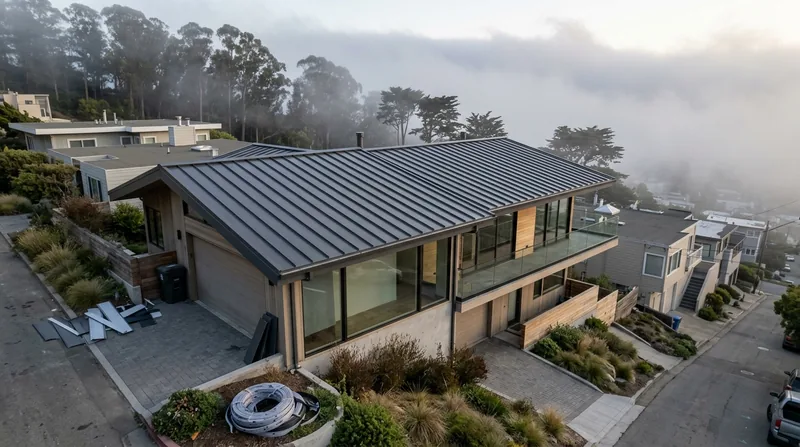




Standing Seam Metal Roofing in San Francisco: Built for Hills, Fog, and Salt Air
When you need Standing Seam Metal Roofing in San Francisco, you need a roof that handles steep hills, marine fog, and salt air without a single exposed fastener to corrode. From the Victorian and Edwardian rows of Noe Valley and the Haight to the modern infill going up in Bernal Heights and Diamond Heights, concealed-fastener panels deliver clean lines and wind resistance that exposed-screw systems cannot match. We have installed these systems since 2009 across the city and the surrounding Peninsula, and we know how Pacific Heights parapets, Marina tile roofs, and Sunset row houses each demand a different detailing approach. If you are weighing standing seam against other profiles, start with our metal roof installation overview to see how the systems compare. Call (628) 356-4308 to schedule a walk of your roof.
Why Standing Seam Matters on San Francisco Roofs
San Francisco sits between the Pacific and the Bay, and the marine fog and salt air rolling in off the ocean attack every piece of exposed metal on a roof. Standing seam panels hide their fasteners under a mechanically seamed or snap-locked rib, so there are no screw heads to rust, back out, or leak. On the steep hillsides of Twin Peaks and Bernal Heights, that same ribbed profile gives superior wind uplift resistance when atmospheric-river storms push through. The long clean lines also satisfy modern infill design review and historic-district expectations in neighborhoods like Pacific Heights and the Haight.
- We roll-form panels to the exact length of each roof run, which eliminates end laps that trap water.
- We mechanically seam the ribs on site so the panel behaves as one continuous membrane under wind load.
- We detail valleys, ridges, and penetrations with matching metal, not caulk and hope.
- We account for thermal movement so panels expand and contract without oil-canning or fastener fatigue.
The result is a roof that stays watertight through decades of fog, salt, and storm cycles instead of needing screw replacement every few years.
Key info: A 1930s stucco row house in the Sunset with a low-slope roof hidden behind a parapet is a very different standing seam job than a steep gable in Noe Valley. We measure slope, parapet height, and panel run length before we quote either one.
For the official rules on roofing permits and inspection thresholds, check the San Francisco Department of Building Inspection before you schedule work.
How We Install Standing Seam on a San Francisco Roof
Every standing seam job starts with the deck, not the panels. We strip the old roofing, inspect and repair sheathing, and install underlayment rated for the slope and the marine environment. Then we set the eave trim, roll-form each panel to length on site, and seam the ribs from eave to ridge. We finish with ridge caps, valley metal, and flashing at chimneys and skylights before we clean the gutters and walk the roof with you.
- We tear off the existing roof and inspect the deck for rot, especially on older Victorian and Edwardian homes.
- We install high-temp underlayment and ice-and-water membrane in valleys and at penetrations.
- We roll-form panels to the exact run length so there are no mid-roof laps.
- We mechanically seam or snap-lock each rib and fasten hidden clips that allow thermal movement.
- We install ridge, hip, and valley trim and flash every chimney and skylight with matching metal.
- We test the roof with a controlled water check and clean all gutters before we leave.
If your home is in a historic district or under HOA design review, we bring panel profile and color samples to the walkthrough so the approval process does not stall the job.
Key info: On a steep Twin Peaks hillside home, we staged panels on the street and hoisted them by rope because there was no side-yard access. That kind of access planning is part of every estimate we write.
For a closer look at how we handle one specific San Francisco ZIP, see our 94102 standing seam page.
Standing Seam Approaches We Use in San Francisco
Not every roof calls for the same panel system. We match the seaming method, panel width, and finish to the slope, the wind exposure, and the look the neighborhood allows. The table below shows the main approaches we install across San Francisco and the Peninsula.
| Approach | Description | Best for |
|---|---|---|
| Mechanically seamed | Double-locked ribs formed on site with a seaming tool for maximum wind and water resistance. | Exposed hillside homes on Twin Peaks and Bernal Heights with high wind uplift. |
| Snap-lock | Panels snap together over hidden clips, faster to install and still fully concealed-fastener. | Modern infill and low-slope roofs where speed and clean lines matter. |
| Narrow-profile panel | 12 to 16 inch panels that read as a tighter, more traditional roof line. | Victorian and Edwardian homes in the Haight and Noe Valley under design review. |
| Wide-profile panel | 16 to 18 inch panels that cover more area with fewer seams. | Large modern roofs and commercial buildings in South San Francisco. |
Standing Seam Metal Roofing Cost in San Francisco: What to Expect
Most standing seam work in San Francisco starts around $10 per square foot for materials and basic installation, and the final number depends heavily on the roof you actually have. A simple gable in Daly City prices differently than a steep, cut-up roof behind a Pacific Heights parapet. Access, deck condition, panel profile, and the amount of custom flashing all move the price. We give you a written scope, not a per-square-foot guess, so you know what is included before you sign.
Factors that push cost up include steep slope and limited staging, complex hips and valleys, chimney and skylight flashing, and historic-district or HOA design review that requires specific profiles and colors. Getting two or three estimates is smart because it lets you compare scope, not just the bottom line. For a detailed breakdown, see our pricing page.
Key info: A homeowner in the Marina with a 1920s Spanish Revival roof asked us to match the original tile look. We priced a standing seam system in a warm color with a narrow profile, and the final number came in higher than a basic gable because of the custom flashing and access.
What to Look for When Hiring a Metal Roofing Contractor Near San Francisco
Hiring a metal roofing contractor near San Francisco means checking more than a license number. Ask for proof of liability and workers compensation insurance, and ask for references from jobs in your neighborhood. Confirm the contractor pulls the roofing permit and understands historic-district and HOA design review, because those approvals can hold up a job for weeks. Get at least three written estimates with clear scope, and ask how they handle deck repair and flashing.
We are a Metal Roofing Alliance member and have been installing metal roofs since 2009. You can reach us at (628) 356-4308 or through our contact page to schedule a free estimate. We will walk the roof with you, explain what we find, and put the scope in writing.
Standing Seam Metal Roofing in San Francisco: Pricing Guide
| Service | Price | Details |
|---|---|---|
| Standing seam installation, basic gable | Starting at $10/sq ft | Includes tear-off, underlayment, panels, and standard trim; slope and access move the price. |
| Standing seam installation, complex roof | Starting at $14/sq ft | Covers hips, valleys, and multiple penetrations; custom flashing and steep slope add cost. |
| Standing seam over existing shingles | On estimate | Retrofit feasibility depends on existing layers, deck condition, and local code limits. |
| Historic or HOA design review | On estimate | Profile and color restrictions may require custom panels and added approval time. |
| Travel | Included | in San Francisco and surrounding areas, no separate call-out or mileage fee |
| Estimate | Free | Response within 24h at (628) 356-4308, no obligation to book |
Indicative pricing, the exact cost depends on square footage, finish, and site access. Free personalized estimate within 24h at (628) 356-4308.


