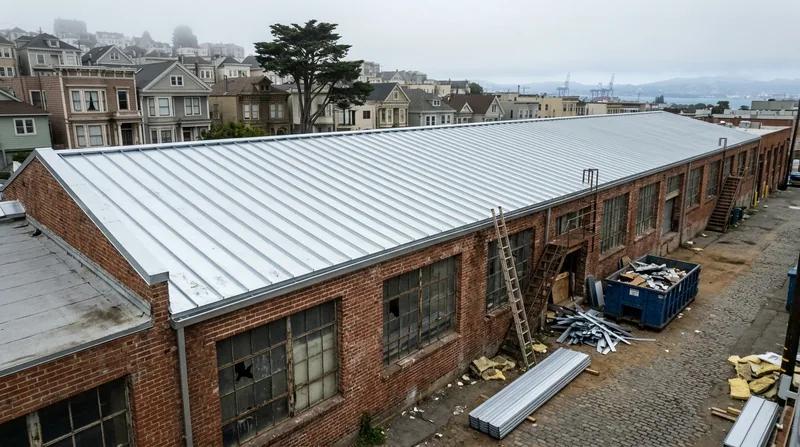




San Francisco's commercial and agricultural buildings sit on some of the most demanding terrain in the country. From the warehouses and workshops of Dogpatch and Bayview to light commercial buildings in SoMa, roofs face salt air off the bay, atmospheric-river storms in winter, and constant wind exposure on hillsides. Barns and outbuildings in Marin and Sonoma add another layer: long panel runs, open framing, and rural access challenges. Commercial & Agricultural Metal Roofing in San Francisco is a different discipline than residential work, and we have installed, repaired, and replaced these systems since 2009 as a Metal Roofing Alliance Member.
We work with building owners, facility managers, and general contractors who need panels that hold up, details that shed water, and a crew that understands local permitting. If you are comparing system types first, start with our standing seam metal roofing page for the low-slope and architectural side of the work.
Why Commercial & Agricultural Metal Roofing Matters on San Francisco's Hills and Shoreline
Commercial stock here is not generic. Dogpatch and Bayview hold older warehouses with low-slope roofs and exposed fasteners. SoMa has light commercial buildings packed tight against neighbors, where a leak travels fast. Churches and workshops in the Mission and Richmond districts sit behind parapets that hide ponding water. Out in Marin and Sonoma, barns and outbuildings take wind and rain on long, uninterrupted roof planes. The dominant failure mode in this city is wind-driven rain pushing past fasteners and through failed sealant at penetrations, not snow load.
- We replace corroded fasteners and dried-out washers before they become ceiling stains inside the building.
- We re-seal and rebuild penetration details around vents, curbs, and rooftop equipment.
- We install continuous panel systems that move water off low-slope roofs instead of trapping it behind parapets.
- We add insulation and thermal breaks where a metal roof over an unheated warehouse is condensing.
- We document existing conditions for insurance and facilities records without promising coverage outcomes.
Every one of those items is cheaper to handle on a scheduled inspection than after a storm.
Key info: A Bayview warehouse we inspected had 14 failed fasteners along the windward edge after a February storm front. Resealing and re-fastening that edge took one day. Waiting for the next atmospheric river would have meant water over stored inventory and a much larger interior repair.
Permits for commercial re-roofs are handled by the local building department, and requirements vary by jurisdiction. The City and County of San Francisco permit portal is the place to confirm what your specific building needs before work starts.
How We Approach a Commercial or Agricultural Metal Roof in San Francisco
Commercial and agricultural jobs fail on access and sequencing, not on panel quality. We walk the building first, map the roof plane by plane, and plan material staging around loading docks, tenant schedules, and narrow SoMa alleys. For rural buildings in Marin and Sonoma, we confirm gate access and crane or conveyor needs before the crew mobilizes.
- We inspect the existing roof, deck, and fasteners and photograph every deficiency.
- We confirm permit requirements with the local building department and pull what the jurisdiction requires.
- We specify panel profile, gauge, and coating for the building's exposure and slope.
- We stage materials and set fall protection before any tear-off begins.
- We remove the old roof, inspect and repair the deck, and install underlayment.
- We install panels, closures, and flashing, then water-test penetrations and edges.
- We walk the finished roof with the owner and hand over documentation.
That sequence keeps a working building dry and keeps the schedule predictable.
Key info: A light commercial building in SoMa had a roof that drained toward a shared party wall. We re-pitched the panel layout and added a new gutter run, which moved water to the street side and stopped the recurring leak into the neighboring tenant space. Projects like this often pair with our metal roof gutter installation work.
Approaches We Use for Commercial & Agricultural Metal Roofing in San Francisco
| Approach | Description | Best for |
|---|---|---|
| Standing seam panel system | Concealed fasteners, raised seams, long panel runs with fewer penetrations. | Low-slope warehouses and light commercial buildings where leak risk must stay low. |
| Exposed fastener corrugated or ribbed panels | Economical through-fastened panels with washer screws at every rib. | Barns, workshops, and outbuildings in Marin and Sonoma on a tighter budget. |
| Retrofit over existing roof | New framing or purlins installed over the old roof where code allows. | Buildings where tear-off would disrupt operations or where existing layers are within code limits. |
| Repair and re-fastening | Replace failed screws and washers, reseal seams, and rebuild penetration details. | Roofs with good panels but failing fasteners after wind and rain seasons. |
| Coating and restoration | Surface prep and elastomeric coating over sound metal. | Older metal roofs that are structurally sound but chalked, faded, or micro-leaking. |
We choose the approach based on the building's slope, exposure, and how long the owner plans to hold it.
Commercial & Agricultural Metal Roofing Cost in San Francisco: What to Expect
Every commercial and agricultural roof here starts with a free on-site estimate, because the number depends on the building, not on a square-foot rate. Roof slope, panel type, deck condition, access, and the number of penetrations move the price more than anything else. A single-story Bayview warehouse with clear truck access prices very differently from a SoMa building with a narrow alley and rooftop equipment to work around.
Repairs and re-fastening are the lowest-cost entry point and the highest-urgency work. Full panel replacement and standing seam installations carry the highest value because they involve tear-off, deck work, and detailed flashing. Retrofits over an existing roof can reduce labor cost when the existing layers are within code limits. For a full breakdown of how we structure numbers, see our metal roofing pricing overview.
Get two or three estimates and compare scope line by line, not just the bottom number. A quote that skips deck repair or flashing replacement is not the same job.
Commercial & Agricultural Metal Roofing Near Me: How to Vet a Contractor Near San Francisco
Hiring for a commercial or agricultural roof is a facilities decision, so check the contractor the way you would check any trade working on your building. Confirm the license and insurance, ask for the certificate, and call references on buildings similar to yours. Ask who pulls the permit and who handles inspection, because that varies by jurisdiction and the answer tells you how the company operates.
- Verify the contractor's license and request a certificate of insurance before work begins.
- Get at least two or three written estimates with itemized scope.
- Ask for references on commercial or agricultural buildings, not just houses.
- Confirm who handles permits and inspections with the local building department.
- Check whether historic district or HOA design review applies to your building's visible roof plane.
If the answers are vague, keep looking. You can also contact us for a free estimate and a straight conversation about what your roof actually needs.
Commercial & Agricultural Metal Roofing in San Francisco: Pricing Guide
| Service | Price | Details |
|---|---|---|
| Roof inspection and condition report | Free estimate | On-site inspection with photo documentation of panels, fasteners, flashing, and deck condition. |
| Repair and re-fastening | Starting at $850 | Failed screw replacement, washer renewal, and seam resealing priced by roof area and access difficulty. |
| Retrofit over existing roof | Starting at $9,500 | New purlins and panels over existing layers where code allows, priced by square footage and slope. |
| Full panel replacement | Starting at $18,000 | Tear-off, deck repair, underlayment, and new panels priced by building size and penetration count. |
| Standing seam installation | On estimate | Concealed fastener systems need on-site measurement of slope, panel runs, and equipment curbs. |
| Travel | Included | In San Francisco and surrounding areas, no separate call-out or mileage fee for the estimate. |
Indicative pricing, the exact cost depends on square footage, finish, and site access. Free personalized estimate within 24h at (628) 356-4308.


