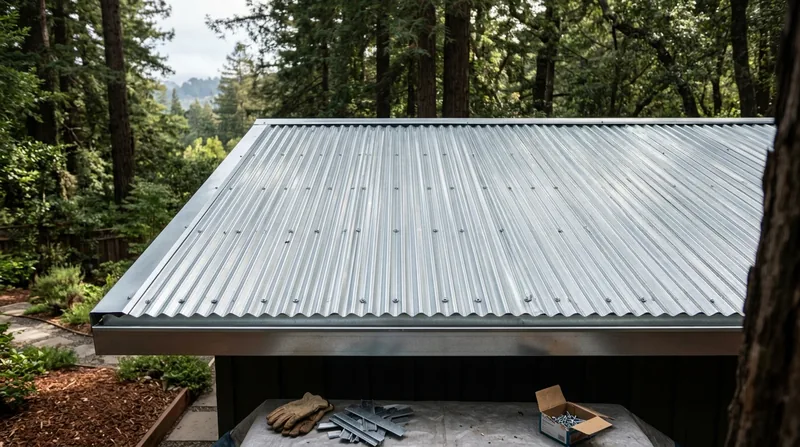




In San Francisco, exposed-fastener metal roofing is the practical answer for the small structures that sit behind and between the city's main roofs. Think backyard studios off a Noe Valley Victorian, a detached workshop behind a Sunset stucco row house, a garden shed on a Twin Peaks hillside lot, or a low pitch porch roof on a Mission District Edwardian. Corrugated & Ribbed Panel Roofing in San Francisco covers the whole family of screw-down profiles: wavy corrugated, R-panel and 5V, all installed with proper screw patterns, closures and coastal-rated finishes. We have been installing these panels since 2009 as a Metal Roofing Alliance member. The work is fast, the material cost is honest, and the panels shed our atmospheric-river rain without the ponding problems flat built-up roofs get into. If you are weighing profiles, start with our metal roof installation page, then come back here for the exposed-fastener specifics.
Why Corrugated & Ribbed Panels Fit San Francisco's Small Structures
San Francisco building stock is not one thing. You have 1880s and 1910s Victorians with bay windows and ornate cornices, 1920s Spanish Revival homes in the Marina under red clay tile, and thousands of 1930s to 1950s stucco row houses across the Sunset and Richmond with flat roofs hidden behind parapets. Behind all of them sit garages, sheds, studios and additions that need a roof that handles wind-driven rain and salt air without a big budget. Screw-down panels do that job well.
- They span open purlins on sheds and studios, which cuts framing and labor cost.
- They drain fast on low slopes where standing water would otherwise sit against a flat roof membrane.
- Coastal-rated painted finishes resist the salt air rolling in off the Pacific.
- They install quickly, so a backyard studio in Bernal Heights can be closed in before the next storm window.
- Damaged panels and loose fasteners are easy to spot and easy to replace.
For accessory structures around the Bay, this is usually the most cost-effective metal roof you can buy.
Key info: A 1950s Sunset District row house often has a flat main roof behind the parapet and a small pitched shed roof over a rear addition. That rear roof is a classic corrugated panel candidate, and it is also where wind-driven rain finds the weakest flashing first.
Before you commit to a profile, confirm what your jurisdiction requires. San Francisco's permit rules for re-roofs and structural changes are handled by the San Francisco Department of Building Inspection, and thresholds vary by scope, so verify current requirements directly with them.
How We Install Corrugated & Ribbed Panels on Bay Area Structures
Exposed-fastener roofing lives or dies on the screw pattern and the closures. We start by measuring the actual slope and span, not the slope the last roofer wrote on a napkin. Then we set the underlayment, align the first panel square to the eave, and drive fasteners on the crest with the correct torque and gasketed washers. Overdriven screws crush the washer and leak within a season.
- We inspect the deck and framing, and we replace any soft sheathing before a single panel goes down.
- We install underlayment rated for the slope and the coastal exposure.
- We set the first panel square, because one crooked panel throws off the whole run.
- We fasten on the crest with the profile manufacturer's pattern and correct gasketed screws.
- We close the ridge, hips, eaves and sidewalls with matching closures and flashing.
- We walk the roof, check every screw, and clean the gutters before we leave.
That sequence is the same whether the job is a 200 sq ft shed or a 2,000 sq ft workshop.
Local example: On a hillside lot in Diamond Heights, a detached studio had a low-slope roof that ponded after every atmospheric-river storm. We stripped it, corrected a low spot in the framing, and installed R-panel at the manufacturer's minimum slope with a lapped underlayment. The owner gained a dry studio and a roof that can be re-screwed instead of rebuilt.
If your panels are already up but the fasteners are backing out, our screw replacement and re-fastening service handles that directly.
Panel Profiles and Fastening Approaches We Use
Not every structure wants the same profile. A garden shed in Pacifica may be fine with 5V, while a workshop in South San Francisco with a long run may be better served by R-panel for its wider coverage and cleaner lines. Here is how the main approaches compare.
| Approach | Description | Best for |
|---|---|---|
| Corrugated panels | Wavy profile with exposed fasteners on the crest, inexpensive and easy to cut on site. | Cottages, sheds and backyard studios on moderate slopes. |
| R-panel (ribbed) | Trapezoidal ribs with wider coverage and a cleaner shadow line, screwed through the crest. | Workshops, garages and longer runs where fewer seams matter. |
| 5V crimp | Classic V-rib profile that sheds water well on low slopes and looks period-correct. | Porch roofs and additions on older Bay Area homes. |
| Concealed-fastener alternative | Standing seam hides the fasteners entirely and moves with thermal cycling. | Main house roofs where appearance and longevity outweigh budget. |
We match the profile to the structure, the slope and the finish warranty, not to whatever is stacked in the yard.
Corrugated & Ribbed Panel Roofing Cost in San Francisco: What to Expect
Exposed-fastener metal is the budget-friendly end of metal roofing, and pricing reflects that. Plan on a starting point of From $5.50/sq ft for a straightforward panel installation with standard trim, and expect the number to move with the details. A small shed with easy ladder access sits at the low end. A steep hillside studio in Bernal Heights with limited staging, or a job that needs deck repair and new flashing, sits higher.
The biggest cost drivers are access and prep, not the panels themselves. Tight side yards in the Richmond, steep driveways on Twin Peaks, and roofs that need sheathing replaced all add labor. Panel profile, finish and color also shift the number, and coastal-rated finishes cost more than standard ones. Getting two or three estimates is the smart move, because scope differences between bids are usually bigger than price differences. Our full pricing overview breaks down the ranges in more detail.
What to Look For in a Metal Roofing Contractor Near San Francisco
Hiring for a panel roof is mostly about verifying basics. Ask for the license number and check it with the California State License Board, confirm general liability and workers' compensation coverage, and request a certificate of insurance before work starts. Ask for references from jobs similar to yours, not just the biggest project in the portfolio. And ask who pulls the permit, because in San Francisco the answer should be the contractor, not you.
Historic districts and HOA design review can restrict panel profile and color, so confirm those rules before you order material. A contractor who has worked in your neighborhood will know the drill. When you are ready to talk through your structure, reach out through our contact and free estimate page or call (628) 356-4308.
Corrugated & Ribbed Panel Roofing in San Francisco: Pricing Guide
| Service | Price | Details |
|---|---|---|
| Corrugated panel roof, standard shed or studio | Starting at $5.50/sq ft | Includes underlayment, panels, closures and standard trim on an accessible roof. |
| R-panel or 5V ribbed install | Starting at $6.25/sq ft | Wider coverage and profile-specific closures; price rises with slope and run length. |
| Tear-off and deck repair included | On estimate | Needed when old roofing, soft sheathing or ponding requires an on-site look first. |
| Steep or limited-access hillside job | On estimate | Twin Peaks and Bernal Heights lots with staging limits add labor and safety planning. |
| Travel | Included | In San Francisco and surrounding areas, no separate call-out or mileage fee. |
| Estimate | Free | Response within 24h at (628) 356-4308, no obligation to book. |
Indicative pricing, the exact cost depends on square footage, finish, and site access. Free personalized estimate within 24h at (628) 356-4308.


